





.svg)

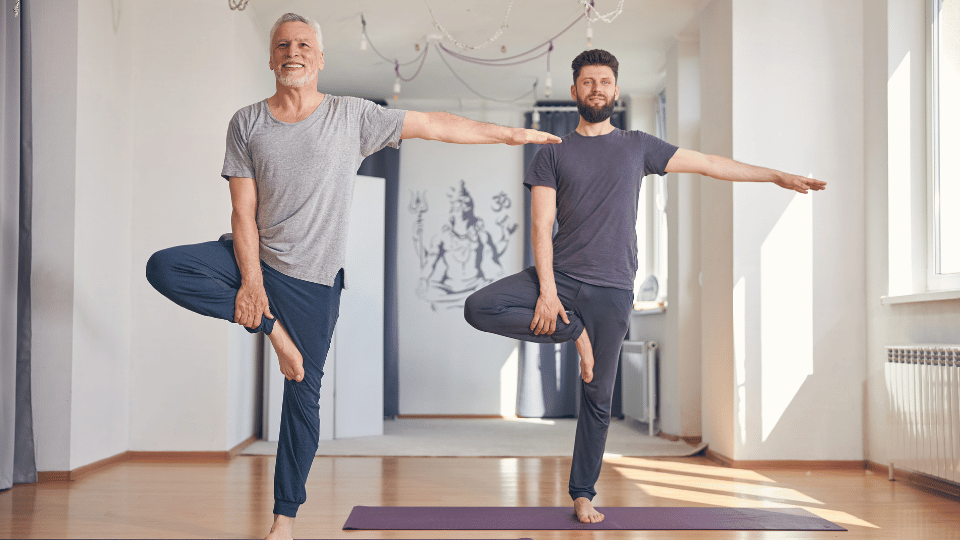


Most workouts have a clear job. Cardio trains your heart and lungs. Strength work challenges your muscles. Balance is easier to overlook, even though you use it every time you step off a kerb, walk on uneven ground or reach for something on a high shelf.
Balance is not something you either have or do not have. It is a skill. Like other skills, it can improve with practice.
What balance training actually does
Staying upright is a team effort. Your eyes, inner ear, brain, nerves, joints and muscles all share information and make quick adjustments. Balance exercises give that system a manageable challenge.
The challenge might come from narrowing your stance, standing on one leg, moving your head, changing direction or reaching away from your centre. Strength matters too, especially around the ankles, hips and trunk. This is why balance and strength exercises often work well together.
A systematic review of 66 studies found that structured exercise improved strength and balance in middle-aged adults. The studies varied widely and were not designed to show whether falls were prevented, so the result should not be oversold. It does show that balance can respond to training before older age.
Why start now
You do not need to wait until balance feels poor. Training it now can support sport, hiking, lifting, quick changes of direction and everyday movement. It also adds a part of fitness that many routines miss.
The American College of Sports Medicine includes balance, agility and coordination in its exercise guidance for healthy adults. For people aged 65 and older, World Health Organization guidance recommends varied activity that combines balance and strength on three or more days a week.
Try this five-minute balance block
Stand near a wall, counter or sturdy chair. Keep a hand close to support, but use only as much help as you need.
1. Feet together: Stand tall with your feet touching or close together for 20 to 30 seconds.
2. Heel-to-toe stance: Put one foot directly in front of the other, as if standing on a line. Hold for 20 seconds, then swap sides.
3. Single-leg stand: Lift one foot a few centimetres from the floor. Hold for 10 to 20 seconds on each side.
4. Heel-to-toe walk: Take six to ten slow steps along an imaginary line.
5. Sit to stand: Rise from a chair and sit down with control five to ten times.
Repeat the block once if it feels comfortable. Add it after your warm-up or between strength exercises two or three times a week.
Make it harder slowly
An exercise should feel challenging without feeling unsafe. When you can complete it with steady control, try one small change:
• use less hand support
• hold the position for five seconds longer
• turn your head slowly from side to side
• reach one hand in different directions
• perform the movement more slowly
Do not rush to close your eyes or stand on a very soft surface. Those changes remove useful information and can increase the chance of falling.
Know when to get help
Stop if you feel dizzy, faint, suddenly weak or in pain. If your balance has changed suddenly, you fall often, or you cannot practise safely near support, speak to a qualified health professional. A physiotherapist or suitable exercise professional can adjust the challenge to your needs.
Balance training does not need a separate hour at the gym. A few focused minutes, repeated often, can train a skill that shows up in almost everything else you do.
Similar articles
Get updates from us
.svg)


